Week 4 · Harvest
Harvest Day
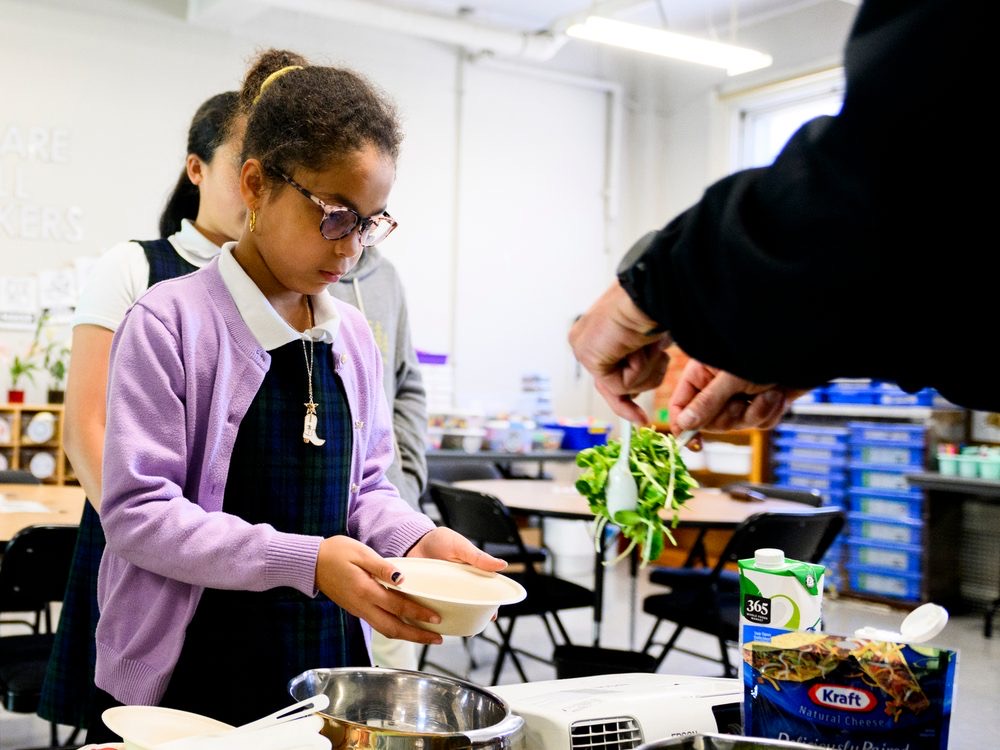
The day has come to taste the fruits of our labor! Students each harvest three microgreen pots, gather the greens, dress them with salad dressing, and dig in. More learning activities are available that help us ground some of the concepts from the course. Congratulations, you may now eat your homework!
Use it your way: teach the full week of activities, pick just the ones that fit, or simply grow the plants and run the Check-In. It is built to flex to your classroom.
The Default Session, 37 Minutes
BYFP’s featured and fixed activities for the week, plus Data Synthesis so the class measures its plants.
| Activity | Time | Takeaway |
|---|---|---|
| Emotion Check-In Mindfulness | 3 min | Naming how we feel helps us show up fully. |
| Mindful Tasting Mindfulness | 7 min | Taste each crop slowly, by hand, and notice how it feels to eat what you grew. |
| Harvest Science · Fixed | 20 min | We grew this. From seed to food. |
| Eating And Emotions Wellness | 5 min | Food and feelings are connected; understanding that helps us make better choices. |
| Grow Lab Check-In (Week 4) Program | 2 min | How has our thinking, confidence, and connection to food changed over four weeks? |
Materials This Week
- Student journals (optional)
- Student pots on the rack (do not distribute scissors yet)
- Washed hands
- Scissors
- Containers to harvest into
- Salad Dressing
- Large mixing bowl
- Tongs
- Paper plates
- Forks
- See video tutorials for visual instructions
- Student journals
- Pencils
What Gets Measured
The Check-In, before harvest. Data Synthesis. Harvest Night family count. Week 4 reflection.
Or Build Your Own
The default session is already loaded in the bar below, shown in green. Add or remove any activity, switch weeks with the filter, then print it or generate slides and a grow journal from exactly what you picked.
All of this mass exists just so that the embryo can turn into a plant. Just like a rocket ship, the outer shell and food supply are discarded after use. The seed can wait years for the right moment to germinate. Isn't it amazing?
Food is connected to who we are, where we come from, and what we love.
Life is a cycle: seed to plant to fruit to seed again.
Photosynthesis is the engine behind all food on Earth.
Plant need XYZ. Let's reflect on how that also applies to taking care of ourselves.
Plants make their own food from sunlight, water, and air, a process we can actually watch.
Seeds have evolved ingenious ways to move through the world - wind, water, animals, and more.
Seeds are living archives of history, culture, and biodiversity.
A baseline we'll return to to see how we've grown.
Recall one part of a seed and name one thing you’re still wondering about.
Putting an experience into one sentence forces us to find what mattered most.
Gratitude, spoken out loud, strengthens community.
Almost everything we eat started as a plant, grown somewhere on Earth.
Growth happens before we can see it. Life has already started beneath the soil.
Everything in nature is connected. Changing one part changes the whole.
Scientists document what they observe; our journals are a record of something alive.
Plants grow in two directions at once - roots anchor and absorb, shoots reach for light.
Food and feelings are connected; understanding that helps us make better choices.
Eating a wide variety of colors means getting a wide variety of nutrients.
Understanding the difference. Reflect on the nuance. Balance is key!
Data from our own plants tells a story about conditions, care, and life.
Water moves through a cycle that connects all living things.
Name a stop in the food system and a reason to choose local food.
Get a basic understanding of how to compare nutrition labels at a glance.
Comparing data across weeks reveals how care and conditions shape growth.
Growing something changes how you see yourself.
Food moves through a complex web of people, land, and energy before it reaches us.
What would we tell someone just starting? That question reveals what we've learned.
Decomposition returns nutrients to the soil. Death feeds new life.
Stillness and patience are skills that growers and people practice.
Food grown nearby is fresher, more nutritious, and easier on the planet.
Designing solutions requires iteration, failure, and creative thinking.
Pollinators are essential partners in our food system. Without them, much of what we eat disappears.
Access to fresh food is not equal. Understanding why is the first step toward change.
What we eat has a footprint, and choosing more plants is one of the most powerful things we can do.
A balanced plate means a variety of whole foods that fuel our bodies and minds.
Name one of the four reasons we eat and a food that does more than one job.
What tastes good and what's good for us overlap more than we think.
Before we celebrate, we pause: what changed in us over these four weeks?
We grew this. From seed to food.
Learning is more powerful when we share it with each other.
The best way to know something is to teach it to someone else.
All our data together tells a story we couldn't see in any single observation.
Sharing what we grew turns a personal accomplishment into a community one.
How has our thinking, confidence, and connection to food changed over four weeks?
Taste each crop slowly, by hand, and notice how it feels to eat what you grew.
Naming how we feel helps us show up fully.
Questions are as valuable as answers. Curiosity grows alongside plants.
We can use our breath to calm our bodies anywhere, anytime.
0 min
Add activities below to build your session.