Fall 2026 classrooms are now booking, reserve a grow lab for your students
How it works
Everything a classroom needs to grow food. In one rack.
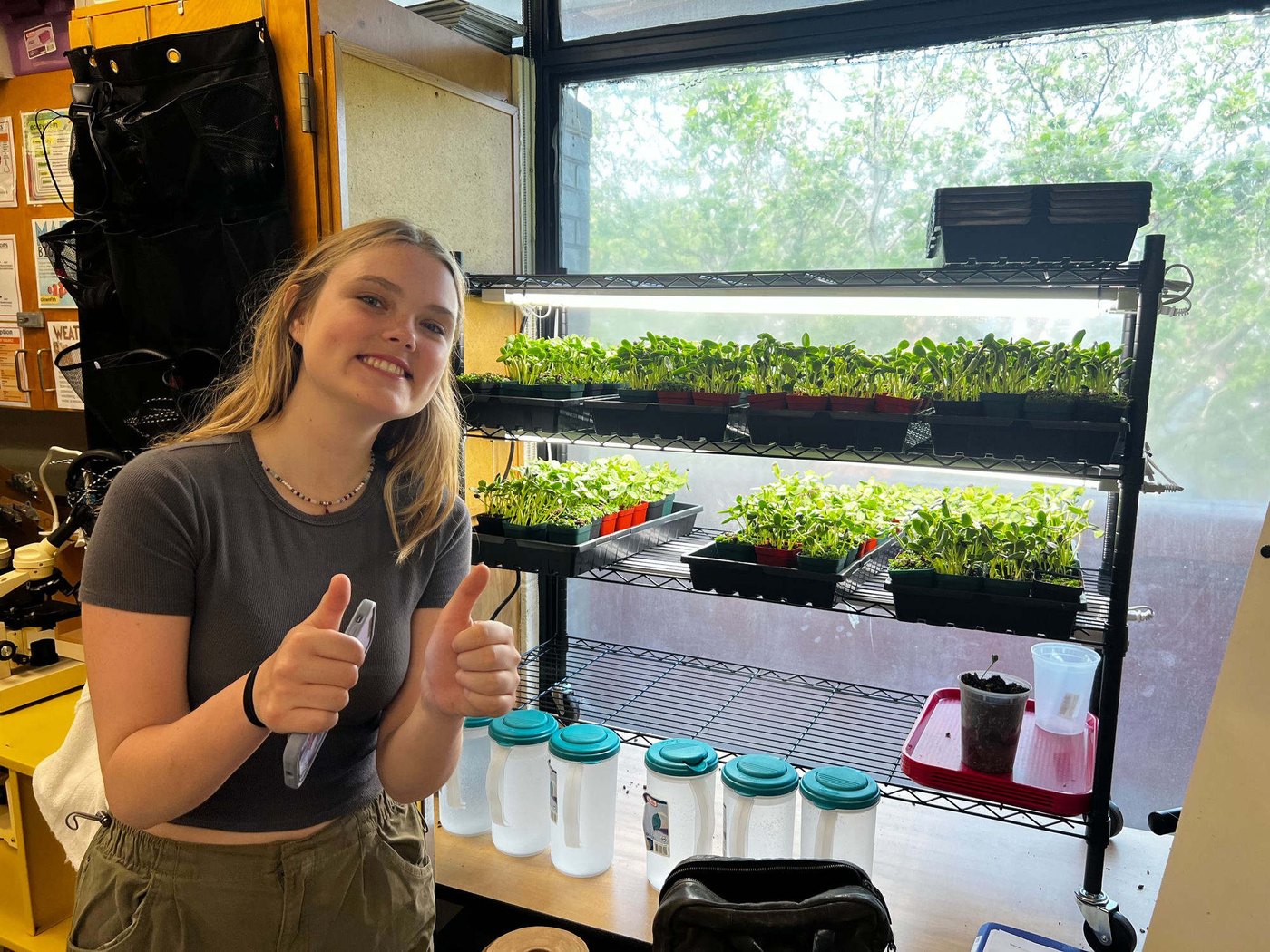
A self-contained indoor growing system built for a working classroom. It ships to your door and sets up easily with a step-by-step guide and video, serves up to 84 students, has a small footprint, needs no outdoor space, and runs as a four-week unit.
We’re not only teaching plant science. We’re handing students back a connection to the earth, to their food, and to each other.
Reconnection
A tray of seeds on a child’s own desk closes the distance between them and the food they eat.
Awe & fascination with nature
Watching a seed split open and reach for the light is a small daily wonder that pulls kids in.
Community
A class plants, tends, harvests and eats together. Growing food has always been how people gather.
Healing
A few quiet minutes a day caring for something alive is good for a child, and for the rest of us too.
Confidence
There’s real, earned pride in growing something with your own hands, and in feeding the people around you.
What’s in the box
1
The Grow Lab
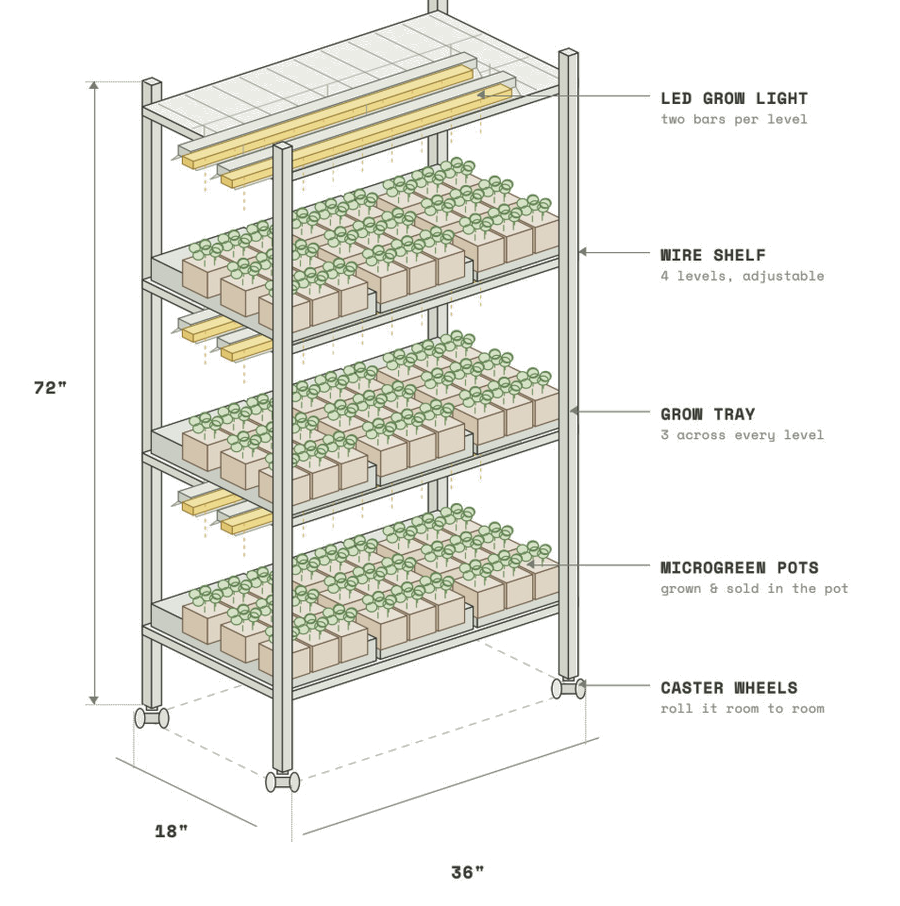
A 72″ rolling rack with four adjustable wire shelves, two LED bars per level and nine grow trays. Enough microgreen pots for every student.
72″ × 36″ × 18″4 levelsOn casters
2
Seeds & soil
Kale, arugula and radish seed, plus bags of potting soil for up to 84 students.
3
Harvest & taste kit
Snip scissors, harvest bins, watering bottles, a mixing bowl, tongs, dressing, plates and forks.
4
Curriculum
Our full standards-aligned curriculum, included with purchase of the kit. Sample here.
5
Simple setup
Delivered to your door with a step-by-step guide and short video that walk you through setting it up.
Week by week
Four weeks, seed to salad
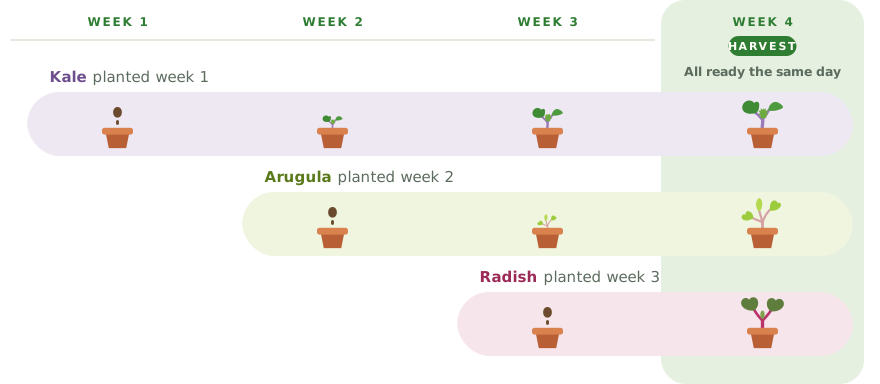
Plant a new crop in weeks one, two and three, then harvest all three on the same day in week four.
Week 1
It All Starts with a Seed!
Week one is all about the magic of nature: understanding the incredible biological features and adaptations of seeds and plants, and drawing some parallels between the needs of plants and the needs of people.
Week 2
Food Is Fuel
This week we explore the relationship between food and our bodies. Students discover what makes food nourishing and why eating a diverse range of foods matters.
Week 3
Where Does Food Come From?
This week is all about systems thinking and feeling our connection to the world around us. Students explore the interconnectedness of our food system, get an overview of where food actually comes from, and learn about the benefits of local food.
Week 4
Harvest Day!
The day has come to taste the fruits of our labor! Students each harvest three microgreen pots, gather the greens, dress them with salad dressing, and dig in. More learning activities are available that help us ground some of the concepts from the course. Congratulations, you may now eat your homework!
Written for you, and free
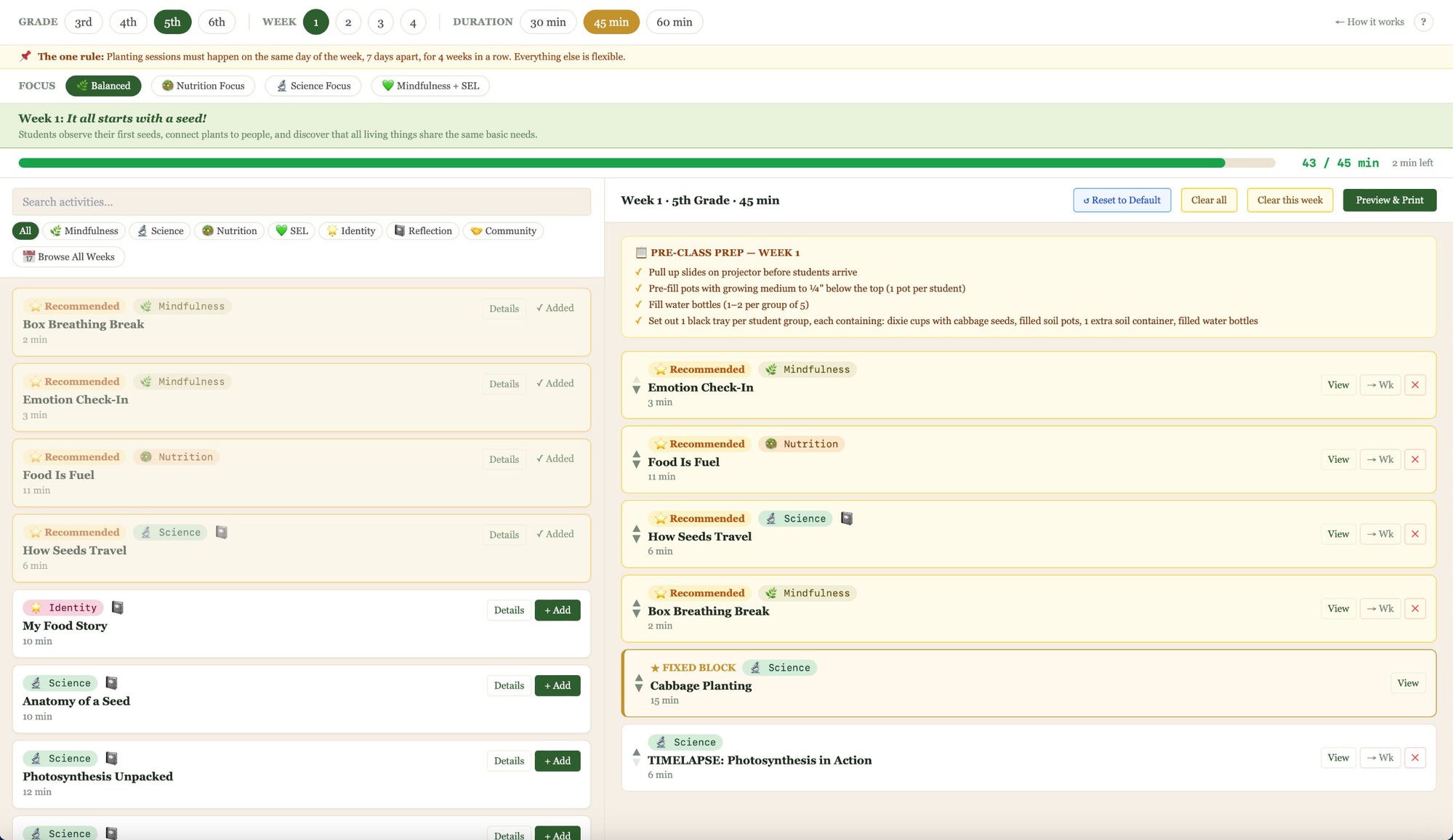
Pre-built lesson plans ready to customize and print!
You never have to write a lesson. Tell us your grade and what you need to cover, and our planner delivers standards-aligned plans, built around your grow lab, that you can tweak and print. The whole curriculum is free and open, so your funding goes to the growing system, not locked-up content.
Simple and guided, with a step-by-step guide and video to walk you through it.
Every day
A couple of minutes to keep the plants watered, an easy job to hand off to your students.
Teaching
Four prepared lessons we build for you, about 45 minutes each, across four weeks.
Training
10 minutes of training videos to understand the planting and harvesting process. It's super simple! Watch them here.
You don't need gardening experience, and nothing about this requires you to be a plant person.
Learning outcomes
Ten learning outcomes, mapped to your standards
Every activity is built around one of ten learning outcomes, and each one is aligned to the current Massachusetts frameworks and the CASEL competencies, so a grow lab counts as core instruction across science, math, literacy, health and social-emotional learning, not an add-on.
10learning outcomes
50+hands-on activities
Gr 5-8core, adapts down to 2-3
MA + CASELframeworks aligned
Plant biology & science
Plant anatomy, lifecycle, germination, photosynthesis and hands-on observation of living systems.
5-LS1-15-PS3-1SEP 1-8
Nutrition & healthy eating
Macronutrients, microgreens, food origin, and the link between what we eat and how we feel.
MA CHPE 20233.1.NE.1-.7
Mindfulness & self-regulation
Box breathing, sensory observation and present-moment awareness as tools for learning and wellbeing.
MA CHPE [ME]CASEL
Social-emotional learning
Self-awareness, empathy and relationship skills through reflections, circles and structured sharing.
CASEL 5
Identity & self-efficacy
Connecting food to identity, building a grower identity, and confidence in one’s ability to grow and create.
CASELSelf-efficacy
Systems thinking
Tracing food from soil to table, the water cycle, decomposition, and how living systems connect.
CCC: Systems5-ESS3-15-ESS2-1
Community & collaboration
Teamwork, circle sharing and civic discussion about food and access.
CASELSL.5.1/.4
Math & data literacy
Measuring growth, calculating rates, charting and analyzing real class data.
5.MD.B.26.SP.A6.RP.A7.RP
Awe, wonder & nature connection
Sensory engagement, germination reveals and a felt connection to living systems.
Awe researchPlace-based
Food prep & culinary skills
Seed-to-plate skills: planting, harvesting, tasting and simple food preparation.
MA CHPE NECTE
Every activity prints with its standard codes and its learning outcomes, so your curriculum team gets an audit-ready record, not a marketing claim. Recurring, weekly and optional expansion activities let a teacher weight the program toward the outcomes they need to hit.
About $12 per student for up to 84 students, and it all arrives in one delivery, ready to grow, right down to the plates and forks for harvest day.
The grow lab
A 4-level rack with LED grow lights, digital timer, trays, pots and cups.
Seeds & growing medium
Kale, arugula and radish seed, plus potting soil for up to 84 students.
Harvest & taste kit
Snip scissors, bins, watering bottles, a bowl, tongs, dressing, and plates and forks.
Setup guide & video
Delivered to your door with a step-by-step guide and video to make setup simple.
Curriculum & support
Our full standards-aligned curriculum, included with the kit (sample here), plus a real person to call anytime.
A one-time purchase you reuse for years, the rack is yours to keep. To grow again you simply restock seed and soil, about $2 per student, or source your own locally.
84students per rack
4 wksstart to Salad Day
~$12per student
$2per student to grow again
How to pay for it
Most teachers don't pay for this themselves
Teachers fund their grow labs through a local sponsor, a small grant, their PTO, or DonorsChoose. We've written the templates for each, and it takes about ten minutes to start.